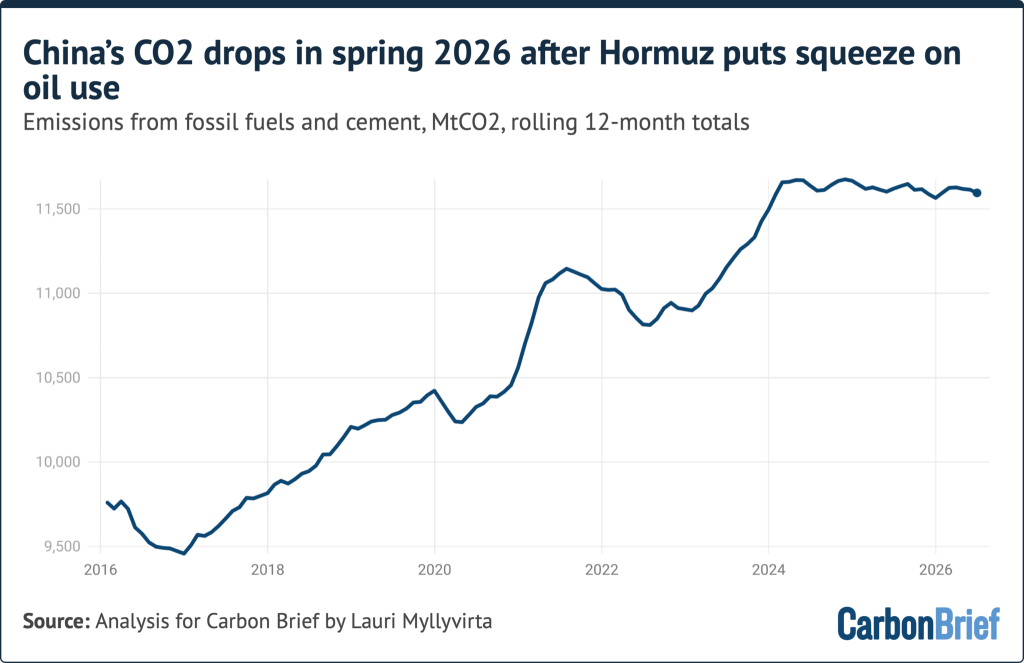
China’s carbon dioxide (CO2) emissions dropped by 1% in the second quarter of 2026, driven by a sharp decline in oil consumption amid the Strait of Hormuz crisis.
Oil use in China fell by 9% overall and by 16% in the transport sector, following supply disruptions from the Gulf. Despite a continued rebound in coal-fired power generation, total CO2 emissions still declined.
This marks the first time that a reduction in oil consumption, rather than coal, has led to an overall decrease in CO2 emissions. Previously, coal consumption was the main factor behind emission changes.
Key findings for the second quarter of 2026 include:
- Electric vehicles (EVs) and public transport have become major influences on China’s oil demand, allowing transportation activity to rise even as fuel use dropped sharply.
- The impact of EVs on oil consumption was nearly double what would be expected from the increase in EV numbers alone, as existing EVs were used more intensively.
- Oil consumption displaced by EVs in the first half of 2026 surpassed the UK’s total oil use over six months.
- Structural factors alone do not fully explain the drop in oil consumption, suggesting that changes in behavior also played a significant role.
- “Curtailment” of solar and wind output led to increased coal power generation, despite strong hydro output, growth in solar and wind capacity, and slower demand growth.
- Significant additions to coal-power capacity and a market that favors coal limited the displacement of coal generation by new wind and solar projects.
- Contrary to expectations, annual growth in coal use for chemical production slowed to 8%, down from 15% in 2025 and 19% in the first quarter.
The second quarter of 2026 was marked by the release of several energy-related five-year plan documents by China’s government. These plans introduced new measures to address solar and wind curtailment and set higher standards for approving new coal-power plants, but included few new quantitative targets.
After a 2% rise in emissions in the first quarter and a 1% decline in the second, emissions for the first half of 2026 are up slightly but remain below their 2023-24 peak.
China is on track to add enough wind, solar, nuclear, and hydropower capacity this year to meet electricity demand growth, even as the pace of new capacity additions slows.
With ongoing structural pressures on oil demand, continued declines in real-estate construction, and slower growth in coal-chemical production, China’s emissions could still decrease this year. The emissions trend remains a balance between energy demand growth and clean-energy expansion, both of which have slowed in 2026.
China’s CO2 emissions from fossil fuels and cement have plateaued for over two years, following a peak in March 2024. Previous analysis described this as a “flat or falling” trend through the end of 2025. A 2% year-on-year increase in the first quarter of 2026 was linked to higher levels of “wasted” wind and solar power.
The latest analysis shows that this was followed by a 1% decline in the second quarter, as illustrated in the figure below. Notably, emissions fell despite increased coal use, with the drop in oil consumption driving the overall decline for the first time.
Within the 1% overall decline in emissions in the second quarter, sector and fuel trends diverged. The largest reductions came from petrol, diesel, and jet fuel consumption, with industrial oil use also falling.
Crude oil processing volumes dropped by 11% in the second quarter, though some of this was offset by drawing down oil product inventories, as Sinopec sales fell by 9%.
China reduced oil imports by 32% in the second quarter. The key question is how much of this was due to actual consumption cuts versus drawing from the country’s large oil stockpiles.
Data from the National Bureau of Statistics shows oil consumption fell by 3% in the first half of the year and about 9% in the second quarter, indicating that reduced consumption played a significant role. However, 60% of the drop in imports was still covered by shifting from building stockpiles to using them.




.svg)