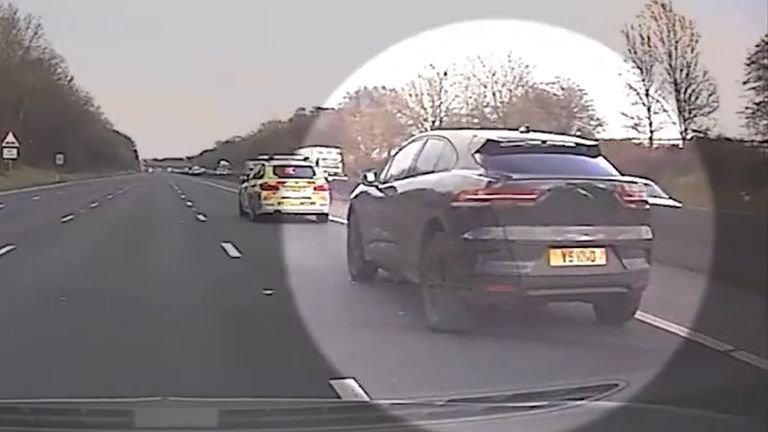
On March 6, 2024, Nathan Owen called police to report that his Jaguar I-Pace electric car had gone out of control on a motorway in Merseyside. He claimed the car had suddenly accelerated and he was unable to stop it. According to The Guardian, the brakes failed to restrain the speeding Jaguar.
Police responded by closing the M58, M57, and M62 motorways in Merseyside to protect other motorists. They surrounded Owen’s car with police vehicles to prevent it from crashing into bridge abutments or other hazards. For over half an hour, the car reached speeds up to 86 mph as Owen struggled to regain control. During this time, Owen’s car collided with police vehicles 33 times. Eventually, the battery ran out and the I-Pace rolled to a stop. Only then, as seen in police video footage, did the brake lights activate.
However, digital evidence contradicted Owen’s account. Jaguar thoroughly examined the car and found it was functioning properly once recharged. Digital time stamps from the car and the police emergency call center revealed the car was stationary with the brake pedal pressed when Owen made his first call. The car only began moving after the call ended, and the brake pedal was never pressed during the 35-minute high-speed incident.
Further investigation revealed Owen was heavily in debt and had missed several car loan payments. Just five minutes before calling police, he had unsuccessfully applied for a loan to address his financial troubles, owing about £5,000 on the Jaguar. Text messages from his phone showed he had previously discussed ways to get rid of the vehicle, possibly by having it written off.
During the initial emergency call, Owen told the handler, “I don’t know how to explain … my car’s not stopping, my car’s stuck at 78 mph and I’m going down the motorway.” He claimed similar incidents had happened before and warned, “I’m coming to a massive bend on the motorway. I’m really shaking.”
Owen’s defense barrister, Daniel Travers, admitted he had little to offer in defense, describing Owen’s actions as “frighteningly stupid for a man ostensibly reasonably well educated and intelligent.” Owen, who had no prior convictions and came from a stable family, was described by his father as a Walter Mitty character who “lives in a fantasy world.”
The prosecutor told the court that Owen sold his story to The Sun and the Daily Mail, describing his “terror ride” and “35 minutes in hell.” He told the Daily Mail, “I felt like a criminal like in a big police chase, that’s how it felt. It felt like Grand Theft Auto.” He received £800 for his story.
Jaguar expressed frustration over the incident, stating it spent £50 million in marketing to counter the negative publicity, which resulted in 180 adverse media reports. The judge was equally unimpressed, sentencing Owen to four years and three months in prison. Owen was also banned from driving for five years after his release, with reinstatement only after passing an advanced driving test.
At sentencing, the judge stated, “You set in train a course of conduct which caused a significant police traffic operation to be deployed, undoubted alarm to the public and very substantial loss and disruption to others.” The judge noted that police officers put themselves at risk, believing they faced a genuine emergency, while Owen sought to profit from a lie.
This story highlights a broader issue about humans and digital technology. Electronic sensors now record our every word and movement, tracking who we speak to and when, as well as every action we take behind the wheel. In many ways, we have created a digital environment where our actions are constantly monitored and preserved for future scrutiny.




.svg)