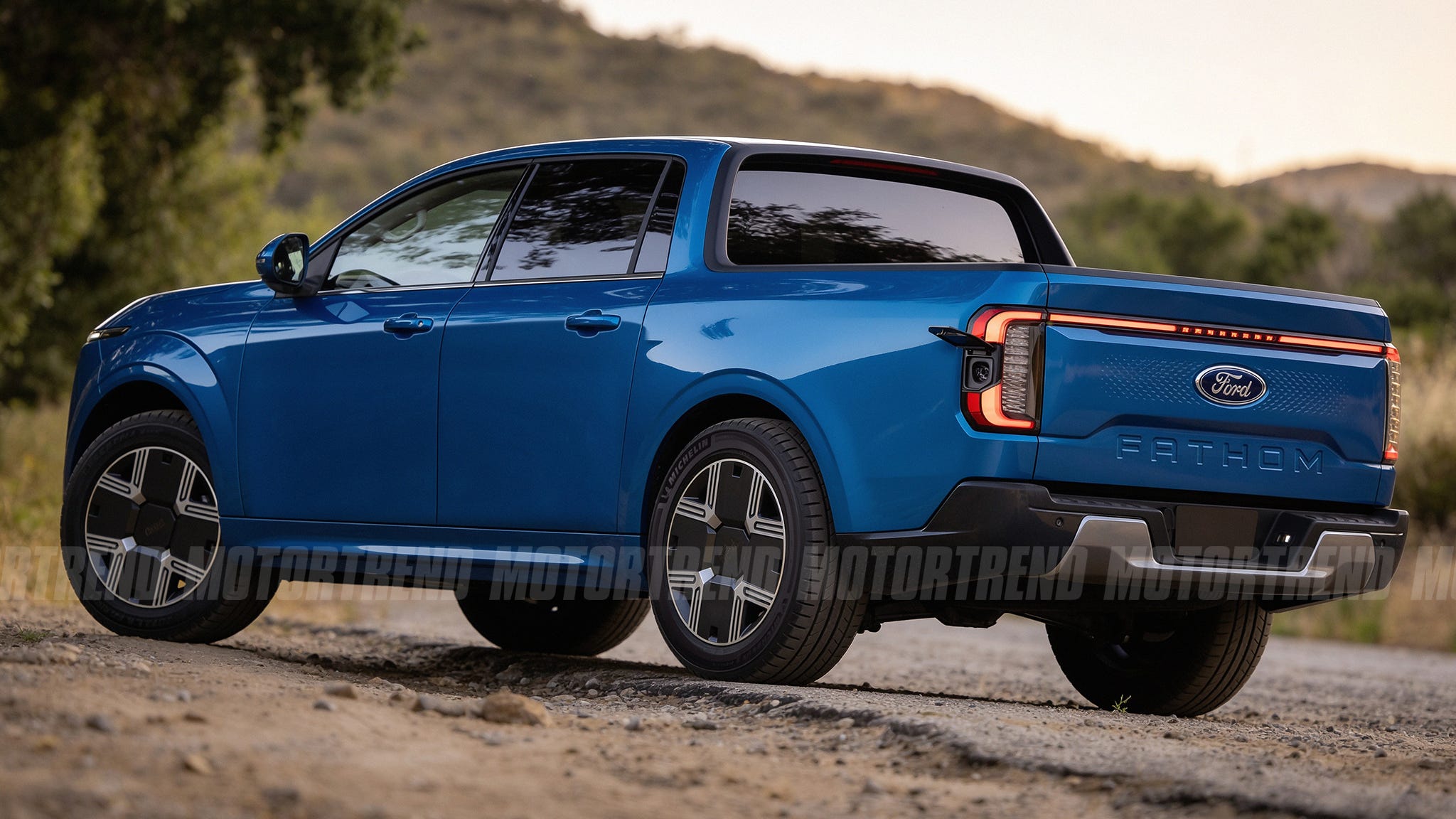
Ford’s Fathom all-electric truck will be built on the Universal EV platform, starting at an MSRP of US$28,350. Additional delivery and destination charges apply, and pre-orders will open early next year.
The Fathom truck features an onboard inverter, enabling bidirectional home energy backup without the need for extra hardware. This marks a shift in EV marketing, as the vehicle’s bidirectional power capability is highlighted over its estimated driving range, which has not yet been disclosed.
EV batteries supply electricity as direct current (DC), while household systems use alternating current (AC), requiring an inverter for compatibility. Fathom uses a DC architecture, but unlike other bidirectional charging-capable EVs, it does not require a separate inverter at the customer’s property to function as a backup power source.
Ford states that the Fathom’s Home Backup Power feature can supply about 10kW of electricity to a home during a grid outage, positioning the truck as an alternative to traditional backup generators. The absence of additional hardware lowers technological barriers for consumers, and the onboard inverter is specific to the Fathom and its Universal EV Platform, though a full lineup has not yet been announced.
Another benefit of Fathom’s bidirectional charging is the Home Power Management feature, allowing the truck to charge during off-peak or low-cost electricity periods and power the home when prices are higher.
When Ford discontinued the F-150 Lightning all-electric pickup last year after a record US$19.5 billion loss, it cited unprofitability due to price cuts. The F-150 Lightning also supported bidirectional charging through a partnership with Sunrun, but required extra hardware for vehicle-to-home (V2H) capability, increasing upfront and installation costs.
Fathom’s lack of required additional hardware for bidirectional charging reduces expenses for customers, though the Ford Home Power Station is still necessary for any bidirectional features. For V2H, customers will also need the Ford Home Backup Power Panel. Ford has not finalized the cost of this equipment but indicated the new AC-capable bidirectional charger for Fathom will be about half the US$1,300 price of the Ford Charge Station Pro, and the combination with the Home Backup Power Panel will cost 60% less than the US$5,200 for the previous system. Installation costs are not included and may vary based on the customer’s home energy setup.
The lower price of the Fathom truck suggests that bidirectional technology is becoming more accessible in the US. Currently, the only other vehicle with an onboard inverter for bidirectional charging is Tesla’s more expensive Cybertruck.
Competing with Tesla and other EV-only manufacturers like Rivian and Lucid may be part of Ford’s strategy. George Whitcombe, senior analyst at Benchmark Minerals Intelligence, noted that US automakers are increasingly competing with these companies, which offer highly software-driven vehicles. He attributes this to a shift in consumer preferences and the need to attract new EV buyers now that tax credits have ended.
Whitcombe explained that, with the end of tax credits and emissions standards, North American automakers must find new ways to incentivize EV adoption. Features like energy management and bidirectional charging, which offer energy security, may appeal to some consumers.
Ford’s launch follows General Motors’ announcement of its next-generation electric architecture. Despite a decline in US EV demand, these launches reflect significant investments and a commitment to innovation. Whitcombe suggests automakers are hedging their bets, maintaining a presence in the EV market to stay ahead of innovation trends both domestically and internationally.
He also noted that range extension is becoming a trend among US carmakers. For example, the F-150 Lightning now offers a battery-powered range extender, allowing Ford to continue developing battery technologies while still providing internal combustion engine options for consumers.